Friday, 18 April 2014

Culture of Death in the Kitchen?


 We all know we're in a stereotypical Catholic home when we come into the dining area and there is some variation of the Lord's Supper over the table. I always found this a gaudy and rather tacky cultural tradition. Yet as I've grown in my faith, and expanded my studies, I've come to understand the profound nature of this traditional set up. And especially, lamenting what appears to be its approaching loss. It's always interesting how information crosses our path to come to, what should be, obvious conclusions.
Interestingly the earliest Christian
document we have is on communion
and the last supper!

A former co-worker of mine had previously been a youth/child social worker. On learning I had children the first thing from his mouth was an emphatic, "Do you eat together at least once a week? The most important part of a stable family is eating together at least once a week!". Although I already knew routine was paramount to family stability, I found the secular emphasis on meals striking. I suppose it should have been unsurprising that regular religious practice was not even thought of in his training; but such is the nature of "multicultural" sensitivity training. At any rate, a year and a half later in a completely unrelated event, I finally got around to renovating my bathroom. A dear contractor friend was kind enough to do the project for us. And as happens as one works on one's home, dreams and suggestions for further work flow as naturally as any construction project of castles in the sky.

In the course of these most entertaining discussions, the suggestion that I turn my dining room into a bathroom and bedroom was brought up. My friend, whose experience I have no reason to doubt in these matters, said "None uses dining rooms anymore. Everyone is building breakfast islands/bars with stools. None is home at the same time anymore. And who eats together anymore anyway?".  This really struck me in an unexpectedly unpleasant manner. Especially as my friend has the enviable blessing of being a faithful catholic from a large and intimate family. Although that casual architectural point brought into sharp contrast the Catholic principle of sacraments being and outward sign of inward grace. What does that say about our priorities when we do not consider eating as a family important enough to devote a significant space for it?

Let us expand on this more broadly. Ignoring the debate on the shifting of emphasis of the Mass to the celebration of the Lords supper rather than on the representation of His sacrifice. Let's take that transferred emphasis as is. As Vatican II rightly exhorts, "the celebration of the Eucharist is the source and summit of our Faith", that is to say the communion of the Lambs Supper; so too then is then, the communion of the family supper. The devoted space and time to the sharing of the meal is the centrepiece of our entire religion. And yet, children and families have created an environment  that makes it almost impossible to understand and participate in the celebration of the Lord's supper as they have no concrete, material, reference to the communion of the family supper? Or vis-a-vis, what significant impact can the communion of the Lord's Supper have on the Family when they have no experience or reference points to the communion of supper in their very own homes?


If I might be allowed to indulge in my Commie lexicon of former convictions... This seems to me to physically impose upon the family a very real alienation from one another. Throwing each member into a radical individualism, divorced from the shared community (communion) of the actual institution of the family. This, tragically, is the self fulfilling cycle of narcissism, ego-centrism, and materialist nihilism that has come from the, so called, sexual liberation of Feminism. And if, dear reader, you espouse the notion that one can be a Catholic AND a feminist, I fear you're exactly the problem being addressed. And make no mistake, feminism has always hated and sought to undermine the communion of the family from the beginning. Emma Goldman, not a "moderate" feminist in any regard, observed this traditional feminist hatred of the communion of the Family in her logically incoherent lament, The Tragedy of Women's Emancipation.

"The narrowness of the existing conception of women's independence and emancipation; the dread of love for a man who is not her social equal; the fear that love will rob her of her freedom and independence; the horror that the love or the joy of motherhood will only hinder her in the full exercise of her profession-all these together make of the emancipated modern woman a compulsory vestal, before whom life, with it's great clarifying sorrows and its deep, entrancing joys, rolls on without touching or gripping her soul."

The natural consequences of rebelling against the Traditional Christian Family Order and general feminist animosity toward it was clear back in 1910! But this overall attitude; this willful blocking of communion and family by way of fear of failure to self aggrandizement, has spread to both sexes and all members of the family. Indeed, what I find so resentful, is that it seems to be so fully embraced by the Church and laity alike. An outright hostility to the plain wording of Ephesians 5 And Genesis 3 regarding the organic and divinely mandated hierarchical structure of the family. As sentimental and moving John Paul II's Encyclical on the Dignity and Vocation of Women my be, it still attempts to explain away the obvious, and give the impression Christianity has historically abusive and oppressive to women. This kidy gloved response only validated the corrosive idea that the traditional communion of the family is always holding each individual member back from more pressing material concerns. Some ethereal and shapeless "liberation" of ones "genius".

And is it not so, in the attempt to realize this "liberation", this "genius", hockey practice, dance lessons, work etc. are always scheduled in opposition to the families supper? Always pressing individual house members into racing through food as a fuel rather than a family communion... especially the mother.  This focus on constant individual enterprises clearly undermines the very ability to engage in family communion supper, let alone the Lamb's supper. We all see it. "Oh we don't go to mass in the summer. We focus on our (insert second leisure property here) in the summer." "Well (insert child here) has (insert activity here) on Sundays.". no sense of authentic communion whatsoever.

Consequentially, therefore, we are now seeing it in the architecture of the kitchen. The outward sign if inward dis-grace. Lifeless, impersonal, anemic, fast food inspired feed bars. What could be a more plain tableaux of the culture of death in the home? Spiritually, emotionally, cut off from each other. Not even facing each other to facilitate the sharing of glances of affection, spur on spontaneous discussion. To be simply alone, with another household occupants body beside you, staring into one's own plate... in ones own thoughts. Int the same place, but alone. The solution is clear; and even sadly easy. To suggest high dining with ones family every day or week is to completely miss the simplicity of the point. The idea is to make the communion less stress filled and hectic. Simply spaghetti and the family around the table. Share in prayer before the meal. It may be the only time the family comes together in daily prayer. Take the opportunity. Discuss the days events, ask questions about the Faith, school, what everyone is reading... the old art of conversation. Put the icon of the Last Supper over your table.

In the end, the death of communion in the home very much seems to be linked to the death of engagement of the communion of Christ's supper at Mass. But we don't need to let it be so. Change your dining area into the genuine practice of the Way of Life. May God bless and protect you and yours. Amen.

Saturday, 12 April 2014

St. Thomas More's response to Bart Ehrman


For some time I've been investing in personal study and research. As I've been lured by the marketing device of being a "life long learner", I've gotten into the Great Courses lecture series. I have been, overall, satisfied in what I've received. That is to say, not surprised that it is all completely atheistic and non-conclusionary reasoning.  "Oh yes, we have all this evidence for the existence of the historical Jesus and what he said; but we can't go so far as to say he rose from the dead and established a divinely guided Church using the same standards that brought us to the conclusion he existed etc." sort of nonsense. And in a round about way that too is what is being addressed here.

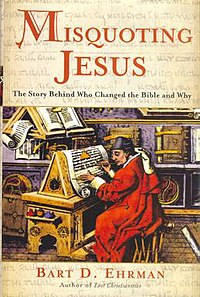
To make a long story short, I ordered The History of the Bible: The Making of the New Testament by the Biblical scholar, and author of Misquoting Jesus: The Story Behind Who Changed the Bible and Why, Dr. Bart Ehrman. I’ll save you much time, money, and eye rolling, and simply tell you it's really only mind blowing to one that believes in the heresy,  and myth, of Sola Scriptura. "The Bible Alone". The good professor basically spends hours telling us that there are variations and discrepancies in the New Testament manuscripts that fundamentally undermine the notion that the Bible's inerrant and divinely inspired. In many cases it’s painful to watch for an armchair scholar and apologist like myself.

Yet, it is quite scandalizing to the average Christian that has been fed a consistent diet of Sunday school, feel good, be nice, don't offend anyone, Jesus is my co-pilot Christianity. A Christianity that has no interest, and no root in Tradition or Church history. We've all encountered them. The Fr. Barrons decrying the Crusades and Inquisitions etc. without seriously understanding what they're distancing themselves from in order to be more appealing to the secularist sentiments of the day. But I digress… The scandal comes from the fundamental misunderstanding of what the Bible is and what it’s meant to achieve. 

So a quick crash course: Apostolic Churches trace their origins from the apostles themselves and therefore Christ himself, not the Bible. The Bible comes from the authority of the Church, not the other way round. This is why scripture itself states the Church is the pillar and foundation of truth... 1 Timothy 3:15. I need to address this point, as at the time of that passage being put to parchment, there was no Bible in existence as we understand it. Forget about it being finalized. The gospels were in a fluid state of transcribing the many oral traditions, events, and biographical points of Christ, His Church, and the doctrines and creeds thereof. Indeed, there is not even a time limit given for when this authority ends. 


Therefore, when Ehrman argues that John 7:53-8:11 is a latter addition, and Mark's ending was "added later" for example, the challenge is not really all that strong. If an oral tradition is still active, and it could be established that the narratives had Apostolic imperator, why would it be remiss to add it to the gospel text at a later date? Or as the early Church called them, the biographies. And I believe this is an important insight. Would we argue that a later addition to a biography of Winston Churchill makes the whole biography suspect because of variations and additions to the text based on newly available information; or to address the immediate needs of the audience the text is intended for? Am I to believe if Dr. Ehrman mat a second edition of his book with additional passages the whole work is therefore subject to severe skepticism? As a teaching tool, obviously an extended ending to the gospel of Mark makes sense for overall catechises. It's not a conspiracy and it’s not certainly not dishonest or discrediting. Is it seriously out of the realm of possibility that the authentic story of John 7:53-8:11 was so beloved, so well known, and so recognized by the community as authentic apostolic teaching, that it was included without resistance by the Christian community at a later date; AKA the inspiration of the Holy Spirit? The criticisms are only scandalous if one sees the Bible as divorced from the authority of the Church as a living teaching tool and prophetic voice of God on Earth; basicly a dead forensic archaeological text. 


Let me give another comparison. The great gothic cathedrals of Europe. These towering monuments have all sorts of additions and variations built into them over time that reflect the teaching mission of the Church. Late medieval stained glass, baroque altars, modernist stations of the cross, contemporary speaker systems, all reside in the same early gothic cathedral. This is why one will never find, or expect to find, a "pure" gothic cathedral. For they are a part of a living Christian community. A community that travels through history and transmits the gospel through the changing periods of that history in different ways. 

Yet it really is better expressed by the man, St. Thomas More in 1528:


"...We are not assured, by any promise made, that scripture will endure to the world's end, albeit I truly think the substance will. But yet, as I say, We have no promise about it. For where our Lord says that his words will not pass away, nor one iota therof be lost, he is speaking of his promises made, indeed, as his faith and doctrine were taught: by mouth and inspiration. He did not mean that of Holy Scripture in writing there would never be lost one iota. Of that, some parts are already lost; more, perhaps, than we know of. And of that we have books in some part corrupted, through miscopying. And yet the substance of these words, what he meant, is known, even where some part of what was written is unknown. He says also that his Father and he will send the Holy Spirit, and also that he himself will come. To what end, all this, if he meant nothing more than that they would leave the books behind and go their way?" (p.142) Dialogue Concerning Heresies

Thus, Ehrman's miscopyings, variations, and additions are not previously unknown, but easily answered. This is why the council of Carthage that finalized the canon of Scripture, and then the Council of Trent  that closed it to addition, didn't make one change to the documents contained in the New Testament. We are to believe giants of intellect like St. Augustine, and St. Robert Bellarmine, and all those before and between, didn't notice differences in the presentation of the texts? Of course they did. It was because of the honesty and teaching nature of the scriptures, and the very nature of the Church, and these Doctors participating in it, that theses biographies were left completely unchanged. This is the beauty of our Catholic Faith that makes us so reasonable in our religion. 


Saturday, 17 August 2013


Statement of Clarification
Saturday, August-17-2013

It has come to the attention of the Crown that an internet site named List of Micronations Wiki: It's a Small World (http://www.listofmicronations.com/lomwiki/index.php/Main_Page) has publish a profile on the Principality of Durstonia. The Crown wishes to thank ww.listofmicronations.com for it's interest and encourages the said site in it's enterprise. However; in reviewing the content of the posted profile it is clear that the contributor(s) have either misunderstood, or was unable to find, relevant information regarding the Principalities publicly stated aims and objectives. As well as certain internal changes that said site would not be reasonably privy to.

The site states,

“Durstonia was created in August 2010 by menswear outfitter and self-declared "very conservative" Roman Catholic Kyle Durston as a vehicle for promoting opposition to abortion, taxation, affirmative action, human rights, the "legal persecution of Christians", "subversion of the jury system", "legalized and institutionalized misandry" and the "persecution of men". Other than Durston, the only named individual known to be associated with Durstonia is one Adam Felice, who is identified as the micronation's chancellor.”

The Principality of Durstonia’s publicly stated position is as follows:

“The Sovereign State of Durstonia is located Lat. 48.3952597, Long. -89.232254. The Principality's political system's an Absolute Monarchy. The state religion's the Roman Catholic Faith & public policy is guided by the maxim "religion, family & duty."

The Principality of Durstonia is a secessionist nation that strives for full independence from the Dominion of Canada based on conscientious objections to the said state’s execution and promotion of mass murder through the violent abortion of children in the womb; violation of the dignity of conscience by legal persecution of Christians through non accountable “human Rights” tribunals; institutionalized racism by way of legalized and institutional affirmative action and subversion of the jury system; theft of subjects liberty, labour and quality of life through enslaving levels of excessive taxation; and violations against the dignity and sovereignty of the family through the legalized and institutional misandry and persecution of men and interference in the family compact. Until such time as a clear majority of residents of the claimed area of the Principality of Durstonia have voluntarily consented to pledge allegiance to the Sovereign State of the Principality of Durstonia, the Principality shall function as a sovereign micro nation.”

Clearly the Principality of Durstonia is not for the “promotion opposition to taxation or human rights”. The Principality of Durstonia is clearly a great proponent of Human Rights. Thus the opposition to unaccountable  “Human Rights Tribunals” that punish individuals based on their religious convictions that are themselves a protected Human Right outside the Rule of Law. The Principality of Durstonia is not opposed to taxation. Rather, the Principality is against the excessive taxation to fund  private interests and ideologies that may or may not be shared by the people they are coercively extracted from; and that would be legitimately, and more effectively, executed by private organizations that would offer whatever service or enterprise it espouses through the consensual donations of like minded individuals. Be that as it may, it would seem a simple “cut and paste” of this statement would have been sufficient for the accurate dissemination of the relevant information. Indeed, the Crown is easily contacted for any information via the sources sited on the profile itself.

Regarding the Honourable Mr. Adam Di Felice D.S.O.D.; He was the first Chancellor of the Principality of Durstonia. The Hon. Mr. Di Felice faithfully fulfilled his duties as Chancellor from August 22, 2010 to February 15, 2013 when his resignation was accepted by His Serene Highness Prince Kyle on a matter of private conscience. The Hon. Mr. Di Felice D.S.O.D. also returned his Distinguished Service Order of Durstonia at that time. This however was not accepted by His Serene Highness and this post nominal shall remain in tact in all public records and future reference to the Hon. Mr. Di Felice D.S.O.D. by the Principality of Durstonia in the grateful regard for his many services and efforts in the foundation and promotion of the Principality of Durstonia. His loss is sorely missed. The Crown wishes the Hon. Mr. Di Felice D.S.O.D. every success and blessing in his future pursuits, and looks forward to the day when His Serene Highness may return to the Hon. Mr. Di Felice’s D.S.O.D. his well deserved Distinguished Service Order of Durstonia. May God grant it so! To date a replacement has yet to fill the position of Chancellor.

The Principality of Durstonia is foundationally resolved to keeping to the premises of subsidiary. In that policy the Crown endeavours always to keep bureaucracy small and leave to the capable hands of Families, individuals, and societies the roles and enterprises they deem important. Thus it is that there will hopefully ever be but few official ministerial names attached to the government of Durstonia. However, in regard to another “named individual known to be associated with Durstonia”, Mr. Rocco Rizzo D.S.O.D. was publicly recognized for services rendered to the Crown on January 30th, 2011. Other than these, and future, officially recognized Fellows of the Order, there is no intention of the Crown to violate the privacy of any Subject, Supporter, or Sympathizer with public recognition.

The Crown sincerely hopes the List of Micronations Wiki: It's a Small World will take these corrections and clarifications in the spirit of Charity in which they are provided and will make the appropriate modifications. We wish the List of Micronations Wiki: It's a Small World the best in it’s vocation and look forward to it’s continued interest.

Friday, 6 January 2012

A Playful Look at the Circular Reasoning of Naturalistic Verificationism


It’s rare one gets a glimpse of themselves in a bygone age… and for myself it was certainly the ghost of Christmas past. I was invited to discuss… well I’m not sure, but it was with an friend of a friend who had become an atheist. In all honestly the only thing I came away with was that this evangelical atheist was really just an angry Christian, but that’s a separate story. It really wasn’t much of a conversation as he was simply parroting New Atheist talking point that are based on fallacious presuppositions but takes a safe intellectual space to unpack them; a space this gentleman is years away from occupying. But I think I’ll play with one of them here. Mostly because it is one of the many reasons I left atheism myself a number of years ago. For me, it’s a rather diverting exercise in irony as for 12 years I held these views myself. So to suggest I didn’t understand or sympathize them would be nonsense. But in mocking these ideas I rather enjoy mocking myself post hoc.

Most religious folks will have run into the arguments I am going to rant about in varying levels of sophistication. But they really are all variations of the simple principles I’m going to poke fun at. And if anyone reading this thinks there will be a “magic bullet” argument that will crush your atheist opponent, think again. Atheists, contrary to their elevated claims, are just as susceptible of cognitive dissonance as any religious person whom is having their world view rigorously criticised. They will simply not see, or perhaps not acknowledge, the contradiction of the foundational principles of their own argumentation.

The first principle of Atheism is naturalism. The Natural world, that is to say the material or physical world is the only thing that we can know to exist and all things can, and must, be explained by these means.  Verificationism is the principle that all these things must be verified via science to be “proven” true. “Proven” is in scare quotes because it’s a fundamentally and scientifically improvable” proposition e.g. prove you’re not a butterfly dreaming you’re a person discussing the existence of God with me.

At any rate, these conversations always come to the “God doesn’t explain anything” variation. This objection springs from not the misunderstanding, but the denial, of anything existing outside the physical world. The classic example of this idea would be an equation like (98 x Q2) / Z + GOD = X. A First Cause does not necessitate an explanation. That is to say, it cannot explain anything. It can give meaning, or lack of meaning given what “it” is; but it cannot be explained further. Naturalistic materialists will jump on the unifying theory of everything, or the multiverse theory, as those are easy outs to get around the clear evidence that St. Aquinas’ cosmological argument for the existence of God, something cannot come of nothing, is exactly what the Big Bang proposes. But if these alternate theories were true, what explanatory value would THEY have; given the stated concept that in order to be valid, something must explain something else and be explained? These Theories would explain nothing at all except the constants of the universe(s), but not the existence of it/them.

Moreover the assumption that the materialist nature of science can even investigate or verify non material, aka the supernatural, using materialist means is a contradiction in terms. Scientists recognize this. Although physical, gravity is an interesting analogy of the premise. We do not know what gravity IS, but we can measure and feel it’s effects. Thus, the immaterial or supernatural can just as easily have the same relationship to the natural world, yet be immeasurable aka unverifiable do to it being non-physical. And due to the atheist’s Anthropic principle that the Universe is just the way it is, none would bother considering the probabilities of such an effect.

Yet even if the theories mentioned above become true, it still doesn’t follow that God does not exist. God as such, could have simply made independently functioning universes; just as the same people assert he universe supposedly made independently functioning and self sustaining life forms.

I am in no way suggesting cities on Mars!
At any rate, the issue of there being no “Made by God” stamp on the universe will come up as “evidence” for God’s non-existence or non influence on the natural order. Usually it’s some insanely large example like “Jesus’ name written on the moon” etc.  But these same people will simultaneously use the anthropic principle to say the universe “is as it is” because it simply cannot be anything else. Well how can we find such evidence when one’s presupposition is that any such evidence is to be accepted as simply not being able to exist any other way. Indeed, Jesus’ name written on the moon would likewise probably be naturalistically explained away by saying we religious people simply created that connection because the human mind naturally tries to make connections and patterns which may or may not be there to successfully compete in the evolutionary race. So even if one could provide the evidence requested, it’s dismissed before it’s submitted.

Yet even if the obvious and imposing “Made by God” standard was readily recognized, it wouldn’t guarantee good behaviour or acceptance by humanity. The very criticisms that atheists make of religious peoples hypocrisy and nasty behaviour is evidence, that even those that really do believe in such a God don’t act in accordance with the obvious consequences that said God’s existence demands. So I fail to see how the big miracles to “prove” God’s existence to all humanity would positively effect man’s indifference and hostility to his fellow man… or God for that matter. The “angry, jealous, God of the Old Testament smiting people” would be supplementary evidence of this point as well. But I digress…

But some will even go so far into self fulfilling prophesy in the miracle discussion that, when given the evidence of the Miracles of Fatima, Guadalupe, the Shroud of Turin and others, they simply reply that “Well we just can’t explain it with science yet. But it doesn’t mean it won’t be explained!” Well la ti da, we get to give rational evidence and place our bets on a rigged roulette table of scientific explanations that may never come as an intellectually honest discussion on the rationality of belief in God. The whole reason for asking for evidence that does not fall into Naturalistic Verificationism is to find something science does NOT explain; not something it MAY explain later. And what if science does not explain it later? And how long is later? Until it can be dismissed as too long ago to be trusted? Is miraculous evidence for the existence of God to simply sit on the back burner of sceptical inquiry indefinitely because it does not support the theory of Naturalistic Verificationism? That sounds more like open ended Dogmatism rather than Rational Inquiry and Scepticism based on Reason.

In the end, the only thing this shows is that for all the high claims of atheists, they fall into the same double standards and cognitive dissonance that anyone does when the foundations of their world view is rigorously critiqued. I’ve even been told that my whole line of reasoning is antiscience (the atheist version of screaming heresy). As though understanding and stating the limitations of science somehow makes one hostile to it. But these are the recriminations of the sour grapes effect of a bruised ego. Thus when one is seriously challenged, or countered, one can simply dismiss reflecting on the points by declaring the opposition “antiscience”, or for using “clever debating tactics”.  “Clever debating tricks” generally being basic philosophical principles like defining terms and using logic to make connections. I probably won’t get around to it, but I should write about how these same folks will claim Logic as a standard for understanding and making sense of the world and reality, but then turn around and say it’s not infallible, but the best we have. Well what failures make it the best we have? The points of science and moral concepts show Rationalism and Logic to be unable to make accurate predictions 100% of the time? e.g. old evidence must be assumed to be inaccurate. An observation about logic and rationalism, by the way, the Popes have consistently asserted since the beginning of the Enlightenment. But are we therefore to proclaim atheists “antilogic”? Of course not. Yet we Theists are to be given a separate standard when recognizing the value of the observance of natural phenomenon by the scientific method and at the same time seeing it’s obvious limitations.

These are the circular reasoning processes that I eventually recognized as an atheist and forced me to become sceptical of my “scepticism”. Like I said, the is no “magic bullet” argument that will defeat someone who has locked themselves in an intellectual feedback loop of circular reasoning. The only thing one can do is challenge the points and wait for the person to find the intellectually safe space to re-evaluate their position and world-view. A debate, where the ego is on the line, is the last place one is likely to change ones world view. But it is a great place to play with concepts and contradictions. If anything it’ll show you how much you need to study, or how desperately the atheist hasn’t been bothered to.

Wednesday, 14 December 2011

Marriage as an Expression of the Culture of Death: If It's Not a Sacrament, It's a Scam!


I work in the Menswear business. Between April and September of every year I’m privy to observe the mass cultural practice of the contemporary wedding ritual. The main observation I’ve made is two fold. One: The wedding is incredibly expensive. Two: There is an attitude of unimportance of the ceremony and it’s importance as a central role of the whole cacophony of activity.

When I look back at the photos of my grandparents and the parishes of my neighbourhood I’m struck by the austerity and frugality of the participants. I grant that many where in the Depression of the 1930’s, but many photos go back to the late nineteenth century and we observe the same thing. Men and their friends in clearly different suits and the groom, in an occasional example of extravagance, sometimes in a visibly new suit. The brides are all in dresses of modest expense and in many cases non white, but brand new for the occasion. The guests are in their Sunday best and sometimes there are ribbons on the gentlemen’s lapels. The event seems very affordable and relaxed. It's as though the emphasis is on documenting something that has already occurred as opposed to something that is still happening. 


What I observe now is the ostentation and complete sense of entitlement in weddings today. What do I mean by that? I’m describing the over the top idea that everyone is entitled to a Disney wedding. Huge and plentiful dresses, tuxedos, magazine quality photos with accompanying moment by moment video documentary film, and a gigantic Godfather scale reception. I hear the laments of the participants in the burdensome expenses of these enterprises. Weddings are seen as a burden for all those involved. The gifts, the reception, the clothes, the venue, the decorations. The whole point of that reception scene in the Godfather was to show the overt display of extravagant wealth was to demonstrate the nefarious power of the Family, not to celebrate the married couple's union. But I digress...

The whole hive of activity has come to focus on ONE person; the bride. Everything, including the groom, is little more than a stage set and props for the bride and her splendour. Many may see this as romantic and sentimental, but in fact I’ve observed the toxicity of this. The event is in the mind of the culture, and more often than not the bride, all about her. It’s routinely expressed as “Her/My day”. It is turned into an ego centric exercise in self esteem and a foreshadowing of the overarching selfish behavior of the bride. This explains the inexplicable endorsement of weddings by all four of my feminist professors, but their simultaneous degrading and undermining of the institution and indissolubility of marriage. The statement of “it’s not about marriage anymore. It’s about princess for a day” was universally chanted by these professors as though to say, "you can still have your wedding as a feminist; but remember, it's really just a glorified Costume ball in your honour". So it’s really no surprise a feminist would endorse something that focuses entirely on the importance of the female to the detriment and exploitation of the male and their union. Indeed, with indoctrination like this, it’s no surprise then that these marriages are destined to fail. I’ve sat across from the domineering bride dictating the colours and styles of tuxedos as though her soon to be “life partner” were an accessory like a handbag, or the little dog that gets to sit in it is perhaps more accurate. I sit thinking, “Dude, this is the tip of the Iceberg”. If I could say one thing it would be "honey, your only a princess to your daddy. GROW UP!" But I belabour the point.

The ceremony itself is not even seen as the wedding anymore. When I ask “where’s the wedding” of the guests, I almost always hear some hall or legion named. To these people it’s not the wedding ceremony in the church or civic building that is the wedding, but the drunken revelry at the reception that is the wedding. Thus is it any surprise that the reception is seen given primary importance by couples, guests and marketeers? A wedding is really become no more than another reason to host another huge party for one’s friends and family. Indeed, is it any surprise the couple’s themselves see it this way. I’ve had many grooms openly acknowledge that the only thing they feel they have to look forward to on their wedding day that has them as an active participant is the reception… and I suspect many more are thinking it, for their actions and conversations infer those same sentiments. I fail to see how a wedding where the groom feels emotionally and culturally alienated from the whole ceremony bodes well for future success.

These narcissistic displays of decadence illustrate the problem of these cultural practices.  These events cost thousands and thousands of dollars and are focused on the material rather than the spiritual emphasis of marriage! Small weddings alone cost at least twenty thousand dollars. The contrast between my grandparents and my contemporaries is starkly displayed in that alone. A couple basically starts their union saddled with the immense debt that could have been used as a down payment of a house. Or more appropriately, the liquidity to comfortably welcome the addition of the great joy and blessing of children. Is it any surprise that people “can’t afford to have children”? Indeed, instead of the cushion of wealth to ease the couple into cohabitation and family, they are initiated into the friction and pressure of crushing debt. Debt that is the death sentence of many marriages. And each precious child cannot help as being seen as another heavy debit on the great ledger against them. Add to this an undercurrent of self centred resentment for the other do to a self esteem addiction and we're sending a divorce lawyers kids to college baby!

The social pressure to conform to this secular ideal is reinforced by the vampiric media and their corporate masters. There is a reason all commercials and television is geared to women. They know women spend more money than men. And they spend it therapeutically  to make themselves feel better about themselves. This is why the movies, television, magazines and advertising all emphasize the expectation to females... from the womb to the tomb. But what of those whom are unable to afford these extravagances. The poor are discouraged from marriage based on these false presentations of what a wedding is. The depression and sting of poverty are most strongly felt when marriage is mentioned to the young working poor. I acknowledge as a man of modest means, I don't even consider dating due to the looming financial expectation. So how can we seriously bemoan “shaking up” when we as Catholics do not condemn and resist the materialist wedding practices of the Culture of Death? "Shaking up" is, in a very real sense, the only affordable option available to these poor souls.

It’s clear to me that the Church has and continues to fail to challenge this attack on the family and Sacrament of Marriage. It is as though the Church is so concerned with attempting to convince people of the importance of marriage in general that it has feared or neglected to recognize the poisonous initiation into it! To break the Culture of Death’s hold upon the wedding the Church must break the materialism and feminist egoism that has infected it so thoroughly. Weddings of modest means must be celebrated as role models of joy; and the honourable and beautiful reasons for them extolled from the pulpit and during marriage preparation. Clearly this alone will not save the Sacrament of Marriage, but I firmly believe that it will contribute to it’s protection and growth. The time has come to see that the Culture of Death is not just a bioethics issue or, God forbid, some ludicrous eco theosophy; but a whole pattern of behaviour that imbues every aspect of the Christian life without rigorous instruction.

If anything I hope this has demonstrated why my maxim of “if marriage is not a sacrament it’s a scam” is completely Justified.


Wednesday, 9 November 2011

Why I Refused the White Ribbon Against Pornography


For the first time in the last four years, I refused to wear the white ribbon. In the previous years I’ve been proud to wear the white ribbon against pornography that was graciously offered by the Catholic Women’s League of my parish. I wore it strait through the week on my suit at work as a testimony to the real problem of pornography in our society. This year however, I was not offered a white ribbon against pornography, but a white ribbon against internet bullying.

“Internet Bullying?“ I asked, “I thought the white ribbon was against pornography?” “Oh it’s the same thing if you think about it” came the quick response of an aging hipster at the door. At this point I became so frustrated and enraged that I broke with my usual decorum in Church and actually blurted out “what kind of feminist nonsense is that?” But being a man of faith, I at least when to know when not to push my extra-religious ideological views on others and took my pew.

Yet this incident has continued to bother me. And it really is an extension of a previous blog I’ve posted regarding the Feminist misandry against male sexuality in the Catholic Church at the moment ( http://durstonia.blogspot.com/2011/06/man-bashing-as-catholic-mainstay.html). In fairness I do not know if this new association regarding the white ribbon is actual or the personal tack on of that particular woman. However that’s not the point.

The point is that at the door of the church, each and every man was presented with a ribbon that said if he was struggling with a sex addiction or struggling with internet pornography, he was not just struggling with unrestrained sexuality, but he was somehow being violent toward women. For let’s be honest; when one says bullying, one’s immediate mental picture is of violence. And contrary to feminist belief, Men are almost exclusively the primary consumers of pornography. So now men, whose natural sexuality is inclined to gain sexual attraction and excitement visually is not only the sin of  promiscuity, but violence as well. This is a hateful demonizing of male sexuality that permeates our society.

This incredibly mean spirited and vicious attack against men who come to Christ with their struggles is reprehensible and inappropriate. I proudly wore the white ribbon against pornography because pornography negatively effects everyone who participates in it, regardless of sex or relation. It’s a protest against those that are exploited by pornography, and those who exploit it. But the fussing of internet bullying to pornography now excludes the main victims of pornography and emphasizes the minority victims. That is to say, it creates a female privileged position in the campaign that moves the issue from universal victimization of pornography, to the users of pornography being violent victimizers themselves.

Only a complete moron would suggest I am supporting or excusing the viewing of pornography. However, if one looks rationally at the relationships within pornography we will see that men are the most negatively effected; not women. Women are paid to make pornography. Except for a small number in production, men pay for pornography. Men become addicted to pornography, and men demonized for it. Pornography is marketed and targeted at men with a ruthlessness that women cannot even come close to conceptualizing. And when a man succumbs to this barrage of psychological marketing, and his natural sexuality, he is to be presented as an internet bully for slapping his pork sausage alone in a dark room with a glowing computer monitor? Really? That is how the Catholic Women’s League is to deal with the issue? To say pornography victimizes women by breaking up marriages and negatively effecting the self image of women is simply to ignore that the other half of those scenarios are intrinsically linked to the exploited men involved and only supports the point I'm making. Men suffer proportionally more than women by the victimizing of pornography.

Is it any surprise male participation in Catholic observance is diminishing when they are intentionally singled out and psychologically victimized for an attack they have supposedly committed, simply by being exploited themselves. It’s ironic that if I were to say a woman was raped because of what she wore; I’d be strung up as a bigot and misogynist. Yet if a man is sexually exploited by a well organized and efficient pornography industry, he’s said to be an internet bully… and there is no outrage at this.

If I appear to be defensive about this issue it is because I am. I, like many if not most men my age, struggle with the temptation and pervasiveness of internet pornography and sex addiction. And to be told my failing in the execution of the resisting of sexual sin is also an act of violence is demeaning and insulting to the magnitude of the struggle I, and many others, grapple with every day. Pornography is a blight and evil. Those that are a victim of it are to be supported and helped, not vilified and condemned by politically driven feminist opportunists trying to win cheap political points at the Church's expense.


I hope to wear the white ribbon against pornography next year, assuming it is a ribbon against pornography and not the exploited victims of it.